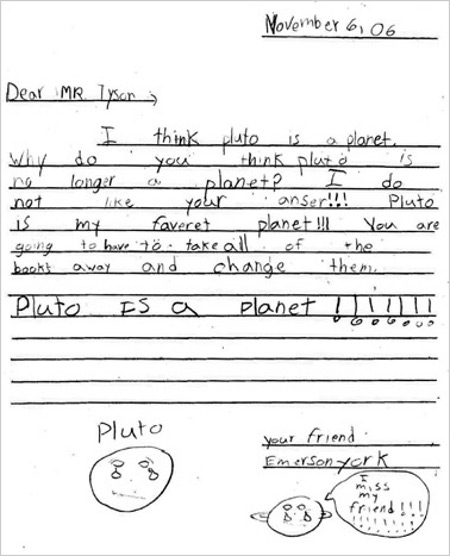
Tiff blogs about how kids get pissed off when they learn that Pluto isn't a planet. BUT! Check out the dateline on that letter -- November 6, 2006. Kids that have been learning about planets since Pluto's been declassified have a completely different take...
Case in point: took the kids to the Chabot Space and Science Center this past weekend, and watched a great film with them about the solar system. My when the kids in the movie flying their animated cardboard rocket finally made it to Pluto my nine year old turned to me with this shocked look on her face and whispered "But Dad! Pluto's not a planet!"
Pluto is still a planet, as are Ceres, Haumea, Makemake, and Eris. Please do not blindly accept the controversial demotion of Pluto, which was done by only four percent of the International Astronomical Union, most of whom are not planetary scientists. Their decision was immediately opposed in a formal petition by hundreds of professional astronomers led by Dr. Alan Stern, Principal Investigator of NASA’s New Horizons mission to Pluto. Stern and like-minded scientists favor a broader planet definition that includes any non-self-luminous spheroidal body in orbit around a star. The spherical part is important because objects become spherical when they attain a state known as hydrostatic equilibrium, meaning they are large enough for their own gravity to pull them into a round shape. This is a characteristic of planets and not of shapeless asteroids and Kuiper Belt Objects. Pluto meets this criterion and is therefore a planet. Using this broader definition gives our solar system 13 planets and counting: Mercury, Venus, Earth, Mars, Ceres, Jupiter, Saturn, Uranus, Neptune, Pluto, Haumea, Makemake, and Eris. At the very least, you should note that there is an ongoing debate rather than portraying one side as fact when it is only one interpretation of fact.
Posted by: Laurel Kornfeld | Mar 11, 2010 at 09:23 PM